
보도자료
막 태어난 젊은 활동은하핵에서
빛이 밝아지는 현상 포착했다
- 밝아지는 특이 천체 ‘3C 138’관측…빛 주 발생지는 전파코어
- 한국우주전파관측망 등 다주파수 동시관측 성과…우주 진화 이해의 단서
한국천문연구원(원장 박장현, 이하 ‘천문연’) 연구진이 주도한 국제 공동 연구팀이 젊은 활동은하핵(AGN, Active Galactic Nuclei)*에서 수년에 걸쳐 빛이 밝아지는 현상을 포착하고, 그 주요 발생 위치를 밝혀냈다. 연구진은 이번에 관측한 활동은하핵 ‘3C 138’의 밝기 증가가 은하 중심부의 전파코어(radio core)에서 일어났으며, 이는 강한 자기장보다는 고에너지 전자의 공급 증가와 관련이 있다는 사실도 확인했다.
* 활동은하핵: 은하 중심부에 있는 매우 밝고 활동적인 영역으로, 중심에 태양 질량의 수백만 배에서 수십억 배 질량을 가진 초대질량블랙홀이 있는 것으로 알려져 있다. 블랙홀이 주변 물질을 끌어당기며 그 주위에 뜨거운 원반이 만들어지고, 일부 물질은 원반의 위아래 방향으로 빠르게 분출하는데 이를 제트라고 한다.
천문연 이상성 박사 연구팀이 관측한 3C 138은 밀집 급경사 스펙트럼 천체(이하 CSS, Compact Steep Spectrum)로 분류되는 젊은 활동은하핵이다. 이는 전파 구조가 아직 모은하 내부에 모여 있을 정도로 작고 젊으며, 전파 대역에서 주파수가 높아질수록 밝기가 대체로 빠르게 감소해 전파 밝기 변화가 크지 않은 천체를 뜻한다.
일반적인 CSS 천체는 전파 밝기 변화가 크지 않지만, 3C 138은 2022년부터 뚜렷한 전파 증광을 보였다. 이후 감마선 활동과 X선 방출 증가도 보고되어 밝기 증가의 원인을 규명할 필요가 있었다. 특히 증광이 전파코어에서 발생했는지, 또는 먼 제트 구조에서 발생했는지를 확인하는 것이 중요했다.
전파 스펙트럼 연구에 따르면, 3C 138의 제트 활동은 수만 년 전에 시작된 것으로 추정된다. 약 46억 살의 태양과 비교하면 우주에서는 이제 막 태어난 아기와 같은 수준이다. 전파 제트의 크기도 약 1만 광년 정도에 그쳐 아직 모은하의 물질과 상호작용하기 쉬운 단계에 있다. 반면 충분히 성장한 전파은하의 제트는 수십만 광년, 때로는 수백만 광년까지 뻗어나가기도 한다.
연구진은 미국의 초대형 전파망원경 배열(VLA, Very Large Array)과 초장기선간섭계(VLBA, Very Long Baseline Array) 관측을 통해 3C 138의 가장 서쪽에 있는 전파코어가 2022년부터 2025년 사이 약 2.6배 밝아졌다는 사실을 확인했다. 반면 주변의 다른 작은 구조와 더 멀리 있는 제트는 뚜렷한 밝기 증가를 보이지 않았다.
이어 연구진은 전파코어가 왜 밝아졌는지를 알아보기 위해 한국우주전파관측망(KVN, Korean VLBI Network)을 이용해 3C 138을 네 개의 전파 주파수 대역에서 동시에 관측했다. 전파코어는 매우 빠르게 변하는 영역이기 때문에 서로 다른 주파수를 같은 시점에 관측하는 것이 중요하기 때문이다.
관측 결과, 전파코어의 스펙트럼은 일반적인 CSS 천체와 달리 특정 주파수에서 밝기가 다시 증가하는 독특한 형태를 보였다. 연구진은 이를 ‘싱크로트론 자체흡수(SSA, Synchrotron Self-Absorption)’ 현상으로 해석했다. 이는 매우 조밀한 영역 안에서 낮은 주파수의 전파가 다시 흡수되면서 나타나는 현상이다.
연구진은 SSA 분석을 통해 전파코어 내부의 자기장 세기를 추정했다. 그 결과, 자기장은 예상보다 약했고, 대신 고에너지 전자들이 새롭게 대량 공급된 것으로 나타났다. 이는 이번 밝기 증가가 자기장 강화 때문이라기보다, 입자 주입 또는 입자 가속이 강화된 결과일 가능성을 시사한다. 또한 이렇게 가속된 입자들은 주변 광자를 더 높은 에너지로 끌어올릴 수 있어, 이번에 함께 관측된 X선 및 감마선 활동 증가의 원인도 설명할 수 있다.
본 연구 논문의 제1저자인 천문연/UST 리선(Shan Li) 연구원은 “이번 연구는 젊은 활동은하핵의 밝기 증가가 어디에서, 어떤 물리적 과정으로 일어나는지를 보여준다”며,“이는 젊은 활동은하핵에서 제트 활동이 어떻게 강화되는지 이해하는 데 중요한 단서를 제공한다”고 전했다.
천문연 이상성 박사는 “CSS 천체에서도 성장한 활동은하핵들과 같이 중심부 제트 활동이 X선 및 감마선 활동과 연결될 수 있음을 확인한 것은 동시 다주파수 VLBI 관측의 중요성을 보여주는 사례”라며 “향후 젊은 활동은하핵의 제트 진화와 고에너지 방출 기원 등 우주의 진화를 연구하는 데 활용될 수 있다”고 밝혔다.
한편 본 연구는 천문학 및 천체물리학 저널(Astronomy & Astrophysics) 2026년 6월 5일자에 게재됐다.
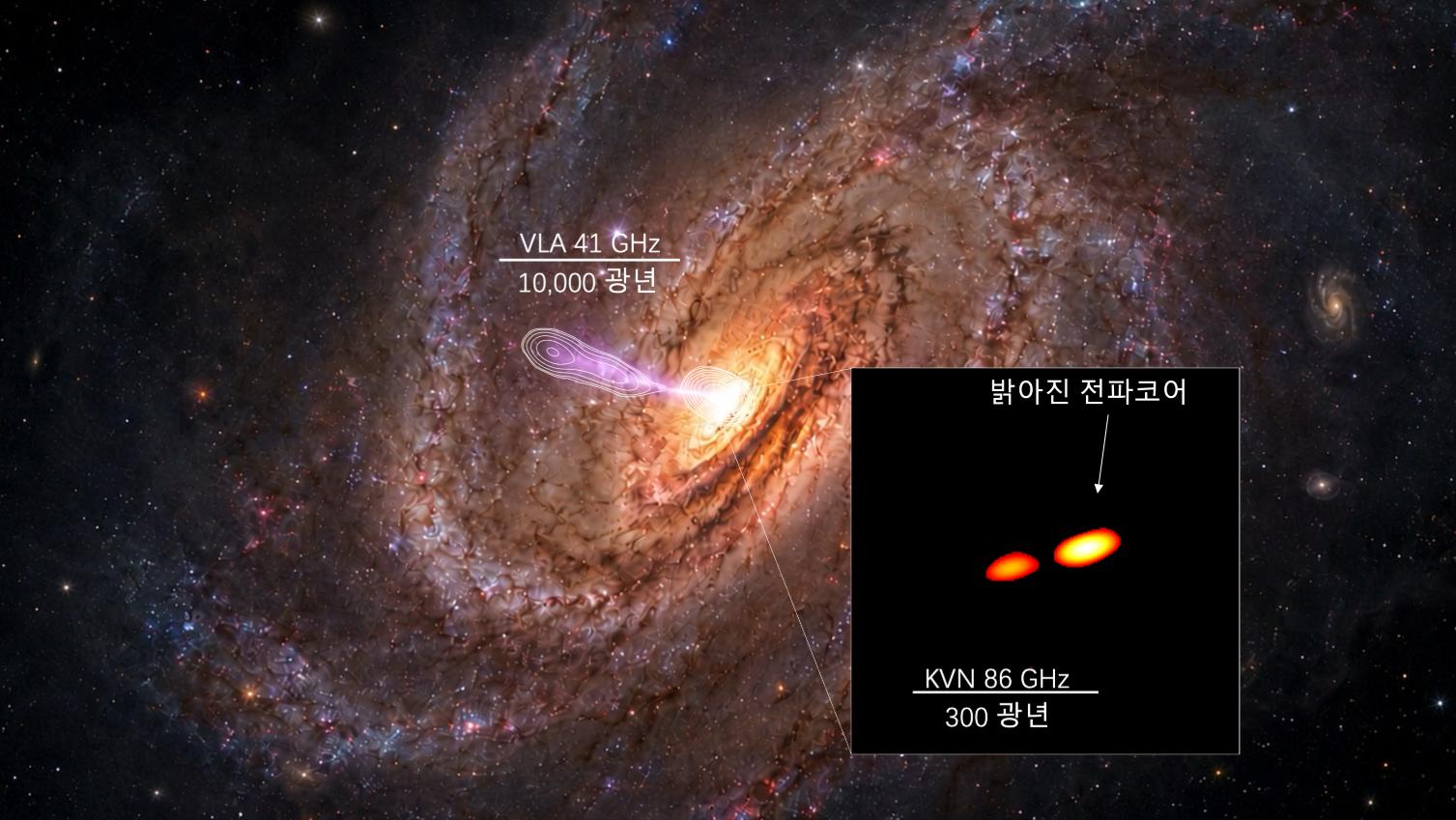
그림 1. 젊은 활동은하핵 3C 138의 전파 제트 구조를 나타낸 개념도. 배경 은하 영상은 실제 관측 영상이 아니라 이해를 돕기 위한 시각적 상상도이며, 그 위에 VLA 41 GHz 관측으로 얻은 전파 제트 등고선과 KVN 86 GHz 코어 영역의 확대 영상을 제시했다.
Brightening Detected in a Newborn Active Galactic Nucleus
An international team led by researchers at the Korea Astronomy and Space Science Institute (KASI) have detected a multi-year brightening event in a young active galactic nucleus (AGN) and identified the primary location where the phenomenon occurred. The team found that the brightness increase observed in the AGN known as 3C 138 originated from the radio core near the galaxy’s center and was likely linked to an increased supply of high-energy electrons, rather than to a stronger magnetic field.
The object observed by Dr. Sang-Sung Lee’s research team at KASI, 3C 138, is classified as a Compact Steep Spectrum (CSS) source — a young AGN whose radio structure is still compact enough to remain confined within its host galaxy. CSS sources typically exhibit spectra in which brightness rapidly decreases at higher radio frequencies and usually show little variability in radio emission.
Although CSS sources are generally stable in radio brightness, 3C 138 began to show a significant increase in radio emission since 2022. Enhanced gamma-ray activity and increased X-ray emission were also reported afterward, raising the need to determine the origin of the brightening. In particular, researchers sought to identify whether the event occurred in the radio core or in a more distant jet structure.
Radio spectral studies suggest that the jet activity in 3C 138 occurs on a timescale of tens of thousands of years. Compared to the Sun’s age of about 4.6 billion years, the source can be regarded as a “newborn baby” on cosmic timescales. Its radio jet extends only about 10,000 light-years, meaning it is still in a stage where strong interactions with material in the host galaxy are likely. In contrast, jets from fully evolved radio galaxies can extend hundreds of thousands or even millions of light-years.
Using observations from the Karl G. Jansky Very Large Array (VLA) and the Very Long Baseline Array (VLBA) in the United States, the team confirmed that the compact radio core of 3C 138 became approximately 2.6 times brighter between 2022 and 2025. In contrast, nearby compact structures and more distant jets showed no significant increase in brightness.
To investigate why the radio core brightened, the researchers conducted simultaneous observations of 3C 138 in four radio-frequency bands using the Korean VLBI Network (KVN). Because the radio core changes rapidly, observing at different frequencies at the same time is essential for accurate analysis.
The observations revealed that the radio core exhibited an unusual spectrum in which brightness increased again at certain frequencies — unlike the typical spectra of CSS sources. The researchers interpreted this feature as synchrotron self-absorption (SSA), a phenomenon in which low-frequency radio waves are reabsorbed within a very dense region.
Through SSA analysis also including archival data from Atacama Large Millimeter/submillimeter Array (ALMA), the team estimated the magnetic field strength inside the radio core. The results showed that the magnetic field was weaker than expected, while a large number of high-energy electrons had recently been injected into the region. This suggests that the brightening is consistent with enhanced particle injection/acceleration rather than requiring magnetic-field amplification. These accelerated particles can also boost surrounding photons to much higher energies, potentially explaining the simultaneous increase in X-ray and gamma-ray activity.
Shan Li, a researcher at KASI and the University of Science and Technology (UST) and the first author of the study, said, “This study shows where brightening events occur in young active galactic nuclei and what physical processes drive them. It provides important clues for understanding how jet activity is enhanced in these young systems.”
Dr. Sang-Sung Lee of KASI added, “Our findings demonstrate that even in CSS sources, central jet activity can be linked to X-ray and gamma-ray emission, similar to what is observed in more evolved AGNs. This highlights the importance of simultaneous multi-frequency VLBI observations and may contribute to future studies of jet evolution and the origin of high-energy emissions in young AGNs.”
The study was published in the June 5, 2026 issue of Astronomy & Astrophysics.
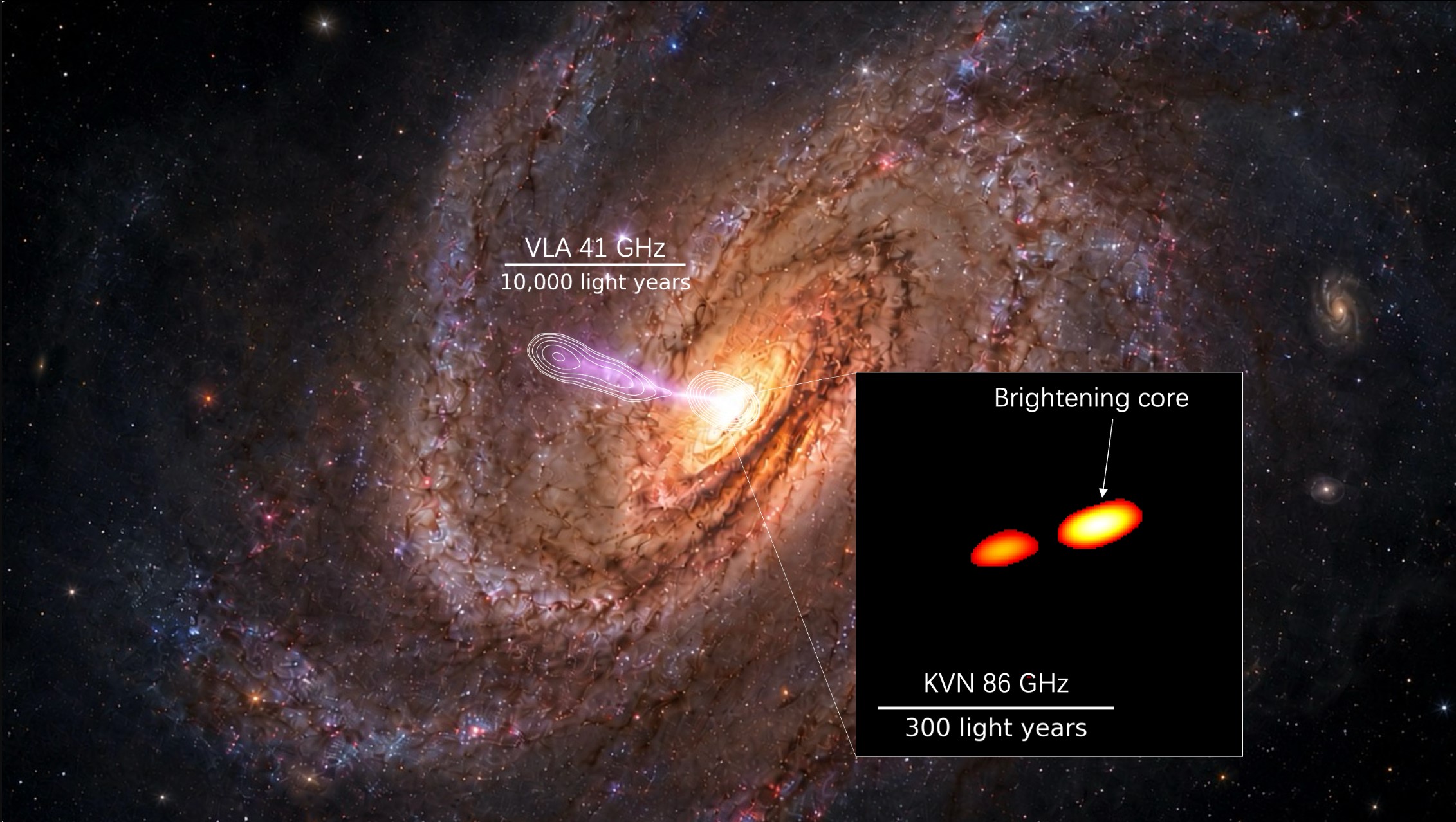
Figure 1. Schematic illustration of the radio jet structure of the young active galactic nucleus 3C 138. The background galaxy image is an artistic illustration rather than an actual observation. Overlaid are radio jet contours from VLA 41 GHz observations and an enlarged view of the core region from KVN 86 GHz observations.
첨부파일(4)
;) 그림 1. 젊은 활동은하핵 3C 138의 전파 제트 구조를 나타낸 개념도.jpg
그림 1. 젊은 활동은하핵 3C 138의 전파 제트 구조를 나타낸 개념도.jpg
 [천문연 보도자료] 막 태어난 젊은 활동은하핵에서 빛이 밝아지는 현상 포착했다.hwp
;) Figure 1.jpg
Figure 1.jpg
 KASI_PressRelease_3C138_EN_F.docx
;)
;)