
보도자료
특이하게 죽어가는 별 발견
- 공전주기 72분의 희귀 왜소신성 발견…
한국이 운영·참여하는 외계행성탐색시스템과 제미니 망원경으로 관측
- 별의 최후와 쌍성 진화 비밀 풀 새로운 단서
별은 수소를 태워 빛을 내다가 수소가 고갈되면 죽음을 맞는다. 우주에 존재하는 별의 절반가량은 두 별이 서로를 공전하는 쌍성계에 속한다. 홀로 있는 별은 비교적 조용한 최후를 겪지만, 쌍성계에서는 두 별의 상호작용으로 다양한 사건이 일어날 수 있기에 별의 마지막을 연구하는 데 중요하다.
한국천문연구원(원장 박장현, 이하 ‘천문연’) 김상철 박사가 주도하는 초신성 탐사 관측 연구진은 외계행성탐색시스템(이하 KMTNet, Korea Microlensing Telescope Network)과 제미니 망원경을 이용해 일반적인 별들과 다르게 진화하며 죽음을 향해 가는 왜소신성*을 발견했다. 이번에 발견한 왜소신성은 기존에 알려진 별들과 달리 두 별 사이의 거리가 매우 가깝다는 특징을 보인다.
* 왜소신성 : 초신성-신성-왜소신성은 쌍성에서 발생하는 폭발현상이다. 순서대로 가장 격렬한 폭발이 초신성, 그보다 규모가 작지만 좀 더 자주 발생하는 폭발이 신성, 가장 규모가 작으면서 훨씬 자주 발생하는 ‘별 밝아짐’ 현상이 왜소신성이다.
태양처럼 홀로 존재하는 별은 비교적 조용한 죽음을 맞기 때문에 마지막 순간을 연구하기가 쉽지 않다. 반면 쌍성계에서는 두 별 사이에 물질이 이동하면서 다양한 현상이 나타나 별의 노년과 죽음에 대한 중요한 정보를 얻을 수 있다. 대표적인 예가 쌍성계의 백색왜성 주변 원반이 갑자기 밝아지는 현상인 ‘왜소신성’이다. 왜소신성은 폭발 규모는 초신성이나 신성보다 작지만, 발생 빈도는 훨씬 더 높아 별의 최후를 연구하는 데 중요한 단서를 제공한다.
천문연 연구진은 지구가 자전해도 최소 한 곳에서는 관측할 수 있는 '24시간 연속 관측' 망원경인 외계행성탐색시스템으로 초신성 탐사를 수행 중이며, 이 과정에서 특이한 왜소신성 'KSP-OT-202104a'를 발견했다. 일반적인 왜소신성의 공전주기는 약 76분 이상이지만 KSP-OT-202104a의 공전주기는 72분에 불과했다. 이처럼 현재 알려진 최소 공전주기보다 공전주기가 더 짧은 천체는 지금까지 9개가 보고되었고 이번 발견으로 그 수가 10개가 된다. 여기에는 이번 발견과 함께 이영대 박사 등이 2022년에 발견한 왜소신성(KSP-OT-201701a)이 포함되어 희귀 천체 10개 중 2개를 한국 연구진이 발견하게 된 셈이다.
공전주기가 짧다는 것은 두 별의 거리가 더 가깝다는 뜻인데, 이러한 특성은 기존의 별 진화 이론만으로는 충분히 설명되지 않는다. 왜 이들 천체의 공전주기가 이처럼 짧고 두 별 사이의 거리가 가까운지 아직 명확한 답이 없으며, 현재 천문학계에서 활발히 연구되는 주제 중 하나이다. 천문학자들은 쌍성 중 질량이 작은 별의 특성에 주목하고 있다. 이 별이 일반적인 경우보다 진화가 더 진행되어 죽음에 더 임박한 상태이거나 헬륨 함량이 높거나 무거운 원소의 함량이 낮거나, 중심부 구조가 더 단단할 가능성 등이 제기되고 있다.
이번 논문의 교신저자인 이영대 박사는 “본 연구는 한국이 개발한 외계행성탐색시스템의 24시간 연속 관측 역량과 한국이 참여하고 있는 세계 최대급 제미니 망원경의 뛰어난 성능을 입증했다”며 “고품질 관측자료 확보에 그치지 않고, 이를 정교하게 해석하고 활용하는 연구진의 역량을 보여준 성과”라고 말했다.
논문의 제1저자인 김상철 박사는 “초신성 탐사 연구는 초신성 자체에 대한 연구성과 창출뿐 아니라, 당초 예상하지 못했던 왜소신성의 발견과 같은 새로운 연구 분야의 장을 연 대표적인 사례”라며 “탐사 자료가 후속 연구를 위한 중요한 토대이자 새로운 발견의 원천이 될 수 있음을 다시 한 번 입증했다”고 말했다.
연구진은 별이 죽음에 이르기까지의 또 다른 경로가 있는지 왜소신성의 진화 과정을 밝히기 위한 후속 연구를 이어갈 예정이다. 본 연구는 미국 천문학 저널(The Astronomical Journal) 2026년 7월호에 게재, 6월 10일에 공개됐다. (보도자료 끝. 추가자료 있음.)
<대표 영상 및 설명>
○ 그림 1. 왜소신성의 메커니즘 상상도.
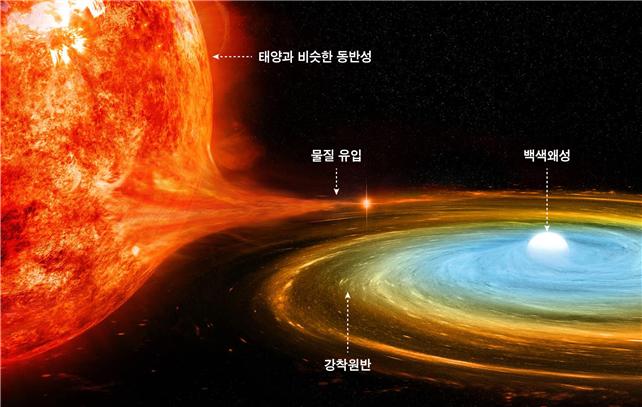
그림 1. 왜소신성의 구조를 보여주는 그림. 두 개의 별이 서로를 공전하는 쌍성을 이룬다. 오른쪽 별이 둘 중 더 무거운 별인 백색왜성으로, 흰색이고 매우 작으며 밀도가 굉장히 높다. 왼쪽의 가벼운 별은 진화 과정에서 부피가 팽창해 색깔이 붉고 오히려 두드러져 보인다. 붉은 별이 팽창하면 물질이 백색왜성으로 유입되면서 백색왜성 자전과 함께 빙글빙글 돌며 원반을 만드는데 이 원반이 폭발적으로 밝아지면서 우리에게 왜소신성으로 관측된다. (그림 출처 : NASA/CXC/M.Weiss)
○ 그림 2. 왜소신성의 진화 경로를 보여주는 그림
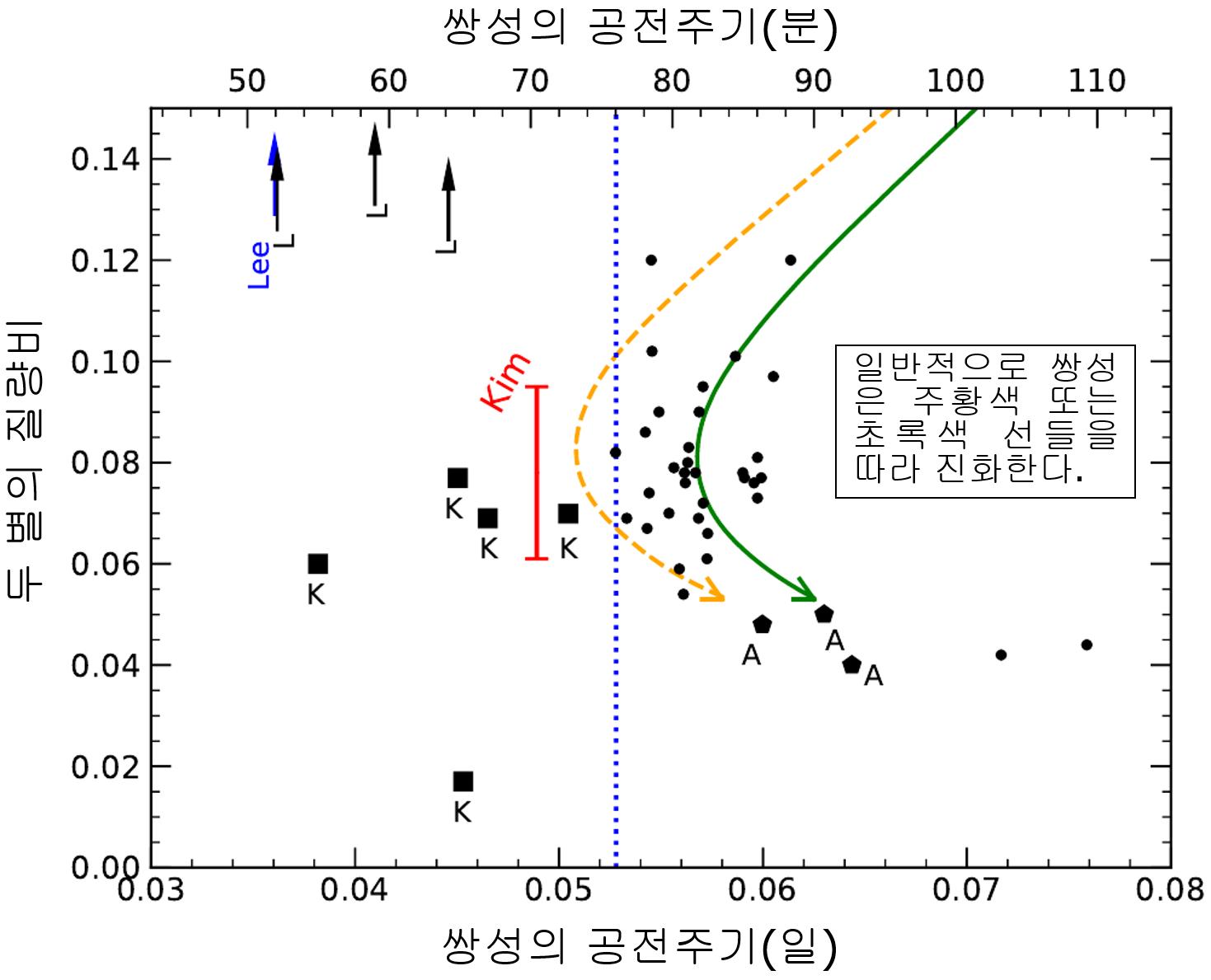
그림 2. 왜소신성은 일반적으로 주황색이나 초록색 선을 따라 진화하며 대부분 선 근처에서 발견된다. 따라서 ‘A’로 표시한 별들의 영역이 죽음에 임박한 지점이라고 여겨진다. 파란색 수직 점선은 왜소신성이 가질 수 있는 최소 주기(약 76분)라고 알려져 있는데, 이보다 주기가 짧은 별이 10개 발견되었고(K그룹과 L그룹) 여기에는 한국에서 발견한 2개(붉은색 I자 모양 수직선에 ‘Kim’으로 표시한 KSP-OT-202104a와 2022년에 이영대 등*이 발견해 ‘Lee’로 표시한 KSP-OT-201701a)가 포함된다. 죽음 직전에 이들의 주기가 왜 이렇게 짧은지는 최근 화제인 연구 주제이다.
○ 외계행성탐색시스템(KMTNet, Korea Microlensing Telescope Network)
외계행성탐색시스템(케이엠티넷, KMTNet)은 한국천문연구원이 동일한 형태의 1.6m 망원경 3기를 남반구의 칠레, 남아공, 호주에 구축하여 운영 중인 천문대 네트워크이다. 미시중력렌즈 현상을 이용해 환경이 지구와 비슷하고 생명체 존재 가능성이 높다고 여겨지는 외계행성을 찾기 위해 2015년 10월부터 가동했다. 남반구 3개 천문대의 위치는 경도 약 120도씩, 또는 각 지역 표준시로 약 8시간씩 차이가 난다. 칠레에서 관측이 끝날 즈음에는 호주에서 관측이 시작되고, 호주 관측이 끝날 즈음에는 남아공 관측소, 그 다음은 다시 칠레로 이어지며 동일 천체 24시간 연속 관측이 가능한 세계 최초의 외계행성 탐색 장비이다. 7∼8월을 중심으로 약 6개월은 우리은하 중심부를 관측하여 외계행성을 탐색하고, 12∼1월을 중심으로 나머지 6개월은 초신성 탐사, 소행성 탐사, 외부은하 관측 등을 진행한다.
※ 외계행성탐색시스템 홈페이지
http://kmtnet.kasi.re.kr/kmtnet/
※ 외계행성탐색시스템 관련 미디어(영상) 파일
https://drive.google.com/file/d/1s3h32bbP_FH-uooQJk35ZZ7MPPwsUEdz/view?usp=sharing
○ 제미니 망원경 (Gemini Telescopes)
제미니천문대의 제미니 망원경은 미국 하와이와 칠레 세로 파촌에 지름 8.1m 대형망원경을 각각 1기씩 설치하여 운영하는 국제 공동 천문대다. ‘쌍둥이자리’라는 별자리 이름과 같이 동일한 망원경을 북반구와 남반구에 설치해서 이런 이름이 붙었다. 현재 단일경으로는 스바루 망원경 및 유럽의 브이엘티(VLT)*와 함께 세계에서 가장 큰 광학망원경으로 꼽힌다. 미국의 켁(Keck)** 10m 망원경과 스페인의 쥐티씨(GTC)*** 10.4m 망원경이 구경은 더 크지만 이들은 조각거울을 이어 붙여 원형이 아닌 6각형 모양이다. 원형의 단일경을 사용하는 8m급 및 조각거울을 사용하는 10m급 망원경들을 모두 ‘세계 최대급’망원경으로 부른다. 천문연은 2019년부터 미국, 캐나다, 브라질, 아르헨티나, 칠레 등과 함께 제미니천문대를 국제 공동 운영하고 있다.
* Very Large Telescope : 유럽연합 공동으로 8.2m 망원경 4기를 남반구 칠레에 건설하여 운영 중
** 켁 : 미국 하와이에 건설한 10m구경의 조각거울 망원경 2기
*** Gran Telescopio Canarias : 스페인이 카나리아 제도 라팔마섬에 운영 중인 10.4m 조각거울 망원경
※ 제미니천문대 웹페이지 https://www.gemini.edu/
※ 제미니천문대 동영상: https://noirlab.edu/public/videos/gemini_demo_real_goebel/
<논문 및 연구팀>
○ 논문
- 제목 : A New WZ Sagittae-type Dwarf Nova KSP-OT-202104a Near the Period Minimum from the KMTNet Supernova Program
- 게재지 : 미국 천문학저널(The Astronomical Journal)
- 게재 일자 : 2026년 6월 10일 (7월호)
○ 연구팀
1. 김상철 (한국천문연구원 책임연구원, KSP* 초신성 탐사팀 한국팀장)
2. 이영대 (한국천문연구원 선임연구원)
3. 문대식 (캐나다 토론토대학교 교수, KSP 초신성 탐사팀 대표)
4. 박홍수 (한국천문연구원 책임연구원/은하진화연구센터 센터장)
5. Yuan Qi Ni (캐나다 토론토대학교 박사후연구원)
6. Nan Jiang (캐나다 토론토대학교 박사과정)
7. 임효빈 (한국천문연구원/UST 박사과정)
* KSP : KMTNet Supernova Program 외계행성탐색시스템의 망원경을 이용한 초신성 탐사 관측 프로그램
A Peculiarly Dying Star: Discovery of a Rare Dwarf Nova with a 72-Minute Orbital Period
- Observed with the KMTNet and Gemini Telescopes by the KASI Researchers
- Providing New Clues to Unravel the Mysteries of Stellar Death and Binary Star Evolution
Stars shine by burning hydrogen in their cores, and when that hydrogen is exhausted, they eventually reach the end of their lives. About half of all stars in the universe belong to binary systems, in which two stars orbit each other. Single stars generally experience relatively quiet endings, but in binary systems, interactions between the two stars can give rise to a wide variety of phenomena. For this reason, binary systems play a crucial role in the study of the final stages of stellar evolution.
Sang Chul KIM and colleages in KASI, who are members of the KMTNet Supernova Program (KSP), have discovered a peculiar dwarf nova that is evolving toward its demise in a manner markedly different from that of other dwarf novae. The discovery was made using the Korea Microlensing Telescope Network (KMTNet), an exoplanet exploration system, together with the Gemini Observatory. Unlike previously known systems, this newly identified dwarf nova is characterized by an exceptionally small separation between its two stellar components.
Single stars like the Sun meet relatively quiet ends, making their final stages difficult to study. In contrast, binary star systems often exhibit a variety of phenomena as material is transferred from one star to the other, providing valuable insights into stellar death. One of the most prominent examples is a dwarf nova, an event in which the accretion disk surrounding a white dwarf in a binary system suddenly brightens. Although dwarf novae are far less energetic than supernovae or classical novae, they occur much more frequently and therefore offer important clues for understanding the final stages of stellar evolution.
The KSP Team has been conducting a supernova search using the KMTNet, a global telescope network capable of continuous 24-hour observations, ensuring that at least one telescope can observe a target at any time despite Earth's rotation. During this survey, the team discovered an unusual dwarf nova designated KSP-OT-202104a. While the orbital periods of typical dwarf novae are generally longer than about 76 minutes, KSP-OT-202104a has an orbital period of only 72 minutes. To date, only nine objects with orbital periods shorter than the currently accepted minimum period have been reported. The discovery of KSP-OT-202104a increases that number to ten. Notably, these ten rare objects include KSP-OT-201701a, a dwarf nova discovered in 2022 by Dr. Youngdae Lee and collaborators. With the addition of KSP-OT-202104a, Korean researchers have now discovered two of the ten known dwarf novae belonging to this exceptionally rare class.
A shorter orbital period implies that the two stars are separated by a smaller distance. However, such systems cannot be fully explained by conventional models of stellar evolution. Why these objects have such remarkably short orbital periods—and consequently such close stellar separations—remains an open question and is currently one of the active areas of research in this field. Astronomers are particularly interested in the properties of the lower-mass companion star in these binary systems. Several possibilities have been proposed: the star may be more highly evolved and therefore closer to the end of its life than is typical; it may contain an unusually high abundance of helium; it may be deficient in heavier elements; or it may possess a more compact and densely structured core. These scenarios are being actively investigated as potential explanations for the observed properties of these rare systems.
Dr. Youngdae Lee, the corresponding author of the study, said, “This research demonstrates both the unique capability of the KMTNet, developed by Korea, to conduct continuous 24-hour observations and the outstanding performance of the Gemini Observatory, one of the world’s largest astronomical facilities in which Korea participates. Beyond obtaining high-quality observational data, this achievement highlights the ability of our research team to interpret and utilize those data with precision and sophistication.”
Dr. Sang Chul KIM, the first author of the paper, said, “The supernova survey has not only produced significant scientific results on supernovae themselves, but has also opened up new avenues of research through unexpected discoveries such as dwarf novae. This study serves as a prime example of how survey data can become an essential foundation for follow-up investigations and a rich source of new discoveries.”
The research team plans to continue follow-up studies aimed at uncovering the evolutionary pathways of dwarf novae and determining whether stars may have alternative routes to their final demise beyond those currently understood. This study was published in the July 2026 issue of The Astronomical Journal (https://doi.org/10.3847/1538-3881/ae6b7f) and was released online on June 10, 2026.
첨부파일(5)
 외계행성탐색시스템과 제미니망원경으로 관측한 왜소신성 KSP-OT-202104a의 모습.mp4
 KASI_Press_Release_260622.docx
;) 그림 2. 왜소신성은 일반적으로 주황색이나 초록색 선을 따라 진화하며 대부분 선 근처에서 발견된다..jpg
그림 2. 왜소신성은 일반적으로 주황색이나 초록색 선을 따라 진화하며 대부분 선 근처에서 발견된다..jpg
;) 그림 1. 왜소신성의 구조를 보여주는 그림.jpg
그림 1. 왜소신성의 구조를 보여주는 그림.jpg
 [천문연 보도자료] 특이하게 죽어가는 별 발견_최종.hwp
;)
;)